
The rules for pharmaceuticals in European waters changed. Two new regulations just hit at the same time. After 22 years working with water quality, I can tell when regulations are about to create a big impact. It is essential we improve urban wastewater treatment in the EU. But we need to make sure this process is possible and sustainable for pharma and cosmetics.
Executive Summary

- EMA revised its Environmental Risk Assessment guidelines (September 2024) (effective 1 September 2024): Expanded Environmental Risk Assessment requirements
- UWWTD created Extended Producer Responsibility fees for wastewater treatment (January 2025)
The critical convergence: The environmental data required for EMA/ERA compliance is crucial. The guideline likely forecasts the foundation for EPR fee calculations. This is especially relevant for the Pharma sector in the new urban wastewater treatment directive in Europe.
Here’s what nobody planned: Your ERA data for EMA compliance will probably decide your EPR fees. For the next decade. Maybe longer.
Part 1: The Compliance Gap – Revised EMA/ERA Guideline
On 1 September 2024, the European Medicines Agency (EMA) introduced a revised guideline for the Environmental Risk Assessments of APIs. The “Environmental risk assessment of medicinal products for human use” (EMEA/CHMP/SWP/4447/00 Rev. 1). These new guideline has expanded the scope and data requirements for market approval of Active Pharmaceutical Ingredients (APIs), now including:
Environmental Risk Assessments (ERAs) are mandatory for all new marketing authorizations, and also:
- Legacy Products (approved before 2006)
- High-Volume Generics
- All PBT/vPvB substances (Persistent, Bioaccumulative, Toxic / very Persistent/very Bioaccumulative)
Impact for Pharma
The EMA/ERA guideline shows a major compliance gap, affecting more than half of existing European pharmaceutical portfolios.
Critical distinction: The primary purpose of the EMA guideline is to mitigate the risk of environmental exposure to APIs. It is not at all intended to restrict market access. If updated and defensible ERA data packages are not produced, compliance issues can arise. These issues are preventable with proper advisory reporting.
EMA/ERA Process and First Warning to Pharma Sector
The EMA guideline consists of an ERA assessment in two phases: Phase I and Phase II. The factors considered are hazardousness (the EMA/ERA guideline defines hazardousness using criteria like Persistence, Bioaccumulation, and Toxicity – PBT). The guideline text thoroughly details the environmental concentrations of the API.
Three Possible Outcomes
- Data Review and Phase I completion
- Data Review and Phase II recommendation
- Data Review and New Laboratory Testing (via Contract Research Organization/CRO, like an external GLP-accredited lab) to fill data gaps identified during review
Note: It is unlikely that an API will need further testing only for a Phase I outcome.
Cost and Timeline Determinants
The complexity, data availability, and hazardousness decide both pricing and timeline. The phase an API requires depends on whether existing literature already provides enough and reliable answers.
Advisory on data quality is fundamental to prevent:
- Delays in reporting submission
- Redundant testing with CRO laboratories
- Unnecessary costs
- Post-marketing commitments
- Delayed approvals
- New application processes
- Compliance violations
Part 2: Recast UWWTD and EPR – Second Warning to the Pharma Sector
A more recent and important regulatory change in Europe is the updated Urban Wastewater Treatment Directive (UWWTD).Directive (EU) 2024/3019 entered into force on 1 January 2025. Pharma and cosmetics are first in line to pay for upgrading wastewater treatment in Europe. The sectors are expected to cover at least 80% of the costs of Quaternary Treatment (Article 9.1).
The critical text here is ANNEX III of the Directive. This explicitly says that the pharmaceutical sector, alongside cosmetics, will have to pay for an EPR fee. :
- Medicinal products for human use falling within the scope of Directive 2001/83/EC of the European Parliament and of
the Council (1).- Cosmetic products falling within the scope of Regulation (EC) No 1223/2009 of the European Parliament and of the
Council (2).
Critical question: The amount each sector will be charged is yet unclear. This will be determined soon by the Commission.
Metrics: Micropollution, Input and Toxic Load
The EPR obligation focuses on a debated claim about how much pharmaceuticals and cosmetics contribute to micropollution in wastewater. The European Parliament’s rapporteur stated:
“According to the Commission, 92% of micro pollutants found in receiving waters come from pharmaceuticals and cosmetics. Micro-pollutants are a serious concern and especially pharmaceuticals – the ones people ingest – are of concern. The rapporteur has concerns about the proposed measures for the EPR scheme.” (Source: https://www.europarl.europa.eu/doceo/document/A-9-2023-0276_EN.html, visited on 24th October 2025).
Also:
The European Commission responded to a parliamentary question in November 2023. It stated that “the pharmaceuticals and cosmetics sectors together account for 73% of the micro-pollutants input quantities.” This reflects their combined contribution by mass or volume entering urban wastewater treatment plants.
These are different metrics, and add confusion to locate the polluter. Crucially, these figures refer to substances entering urban wastewater treatment plants. They do not refer to “micropollutants found in receiving waters” as the Parliament text suggests.
Two Critical Metrics INPUT vs TOXIC LOAD
The Commission’s Impact Assessment (Document SWD/2022/541) or the “BioInnovation et al. (2022) study”, pharmaceuticals and cosmetics together make up:provides a more granular breakdown, distinguishing between the combined contribution of both sectors and the specific contribution of pharmaceuticals for human use alone:
Combined (Pharma + Cosmetics):
- 73% of input quantities – physical mass/volume entering wastewater treatment plants
- 92% of toxic load – hazardousness weighted by environmental toxicity.concentrations.
Pharmaceuticals for Human Use Alone:
- 59% of input quantities – physical mass (kilograms/tons) or volume of substances entering wastewater treatment plants
- 66% of toxic load – hazardousness weighted by environmental toxicity, using metrics such as Predicted No-Effect Concentration (PNEC) to assess ecological impact
Critical insight: A small quantity of a highly toxic substance can dominate the toxic load calculation. But this is a relative measure. It represents minimal input by mass. This explains why Pharmaceuticals alone are being accounted for 66% of toxic load despite representing only 59% of input quantities. Certain pharmaceutical compounds are particularly hazardous even in low concentrations (e.g. antimicrobial=antibiotics and endocrine disruptive molecules=hormones). This is why the case based on toxic load sounds more compelling towards a large EPR for pharma.
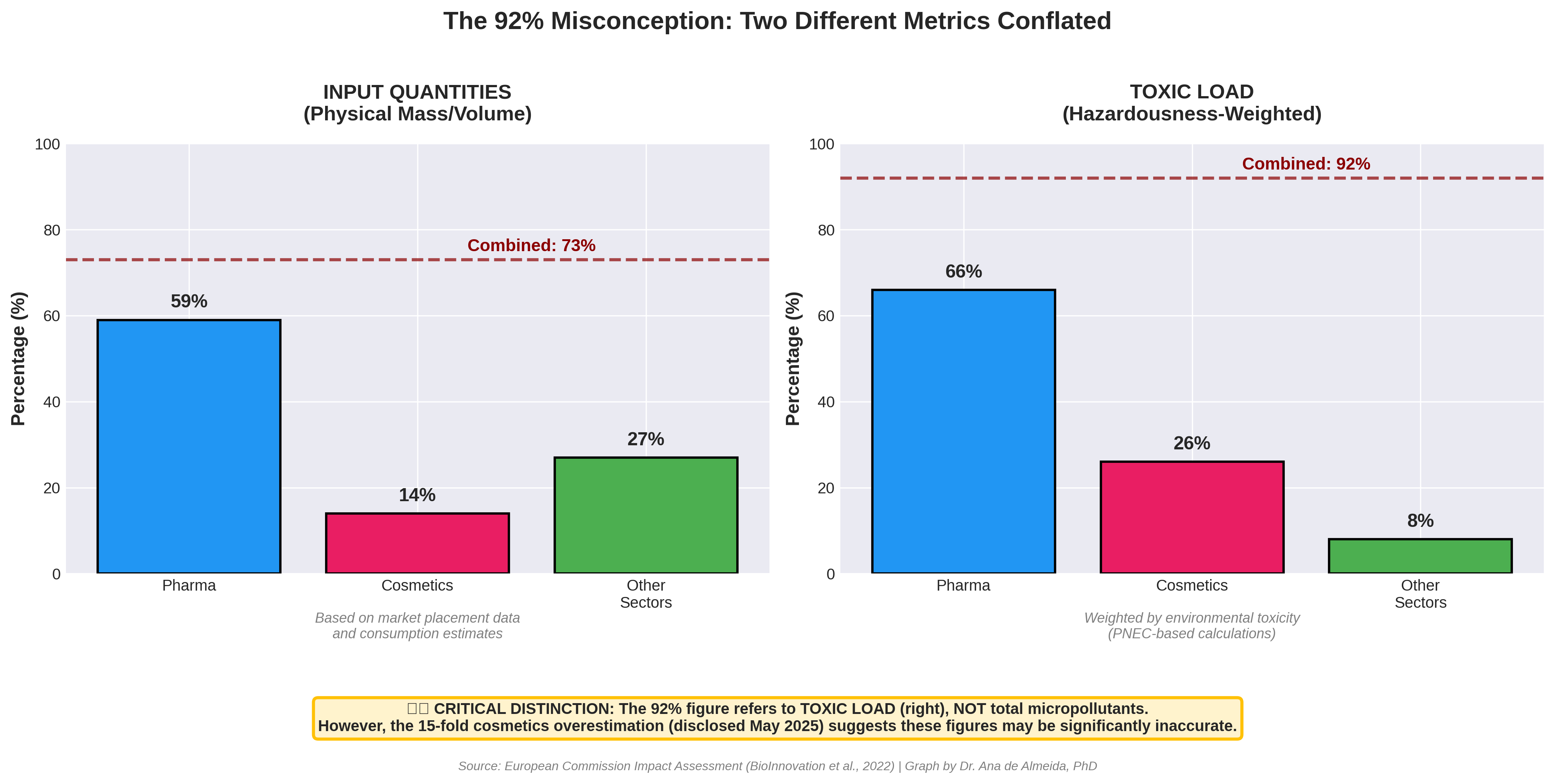
Fig. 1 The European Commission attributes 73% of micropollutants input quantities (physical mass) to pharmaceuticals and cosmetics. Additionally, it attributes 92% of toxic load (hazardousness-weighted) to these sectors together. These are two distinct metrics often causing confusion in public discourse. It raises critical questions about the scientific basis for EPR fee allocation under Directive (EU) 2024/3019. (Sources European Commission Impact Assessment). Claude Advanced used to produce image directly prompted from my research. The toxic load for cosmetics “26%” comes from a JRC list, and is a number which is being challenged recently. A May 2025 disclosure by Cosmetics Europe revealed this is gap between actual contributions and estimations. This raise questions about the accuracy of the numbers.
Pharma’s Is Being Discriminated: Firm Data Analytics Testing the Numbers is the needed defense
The contribution of Pharma and cosmetics to micropollution in wastewater is recognized, studied, and factual. Pollution sources are more diffused and nuanced than the EPR scheme acknowledges. Contributions come from diverse sources including plant protection products, industrial chemicals, cleaning products, petrochemical residues, and road pollution. The problem here is very simple: these sources (polluters) are not being held financially accountable.
A document from the Irish Pharmaceutical Healthcare Association clearly states that the pharmaceutical industry is taking significant risk contingencies. They are already treating wastewater in production facilities. The IPHA says the industry is committed to step up in larger responsibilities. They call out that the Directive violates the Principle of Proportionality. It also breaches the Principles of Non-Discrimination. The Irish pharma cluster warns of a potential wait until 2033. This is for the EC to evaluate the impact of the UWWTD on polluters. Until then, single producers, especially of generics, will suffer unsolvable financial pressure.
- No study has yet empirically and firmly confirmed the models and estimations behind these percentages
- Directive (EU) 2024/3019 does not require other polluting sectors to upgrade wastewater treatment in Europe, raising questions about equity.
- Key areas of criticism include research bias, data misattribution, and limited cost calculations
- Pharma and Cosmetic industries reply to this have expressed massive concern on these attributions, see more below:
- In short, Pharma and cosmetic groups argue there is not enough scientific basis for sector allocation. They recommend reviewing the available analyses.
- See detailed response from Pharma at Medicines for Europe analysis and the related Ramboll Report.
Key Industry Concerns
According to Medicines for Europe, the greatest risk is to European patients. Based on EPR fee simulations:
- In all scenarios, generics producers would bear 57-62% of the EPR fees
- This would make their production economically unfeasible
- The price of cosmetics and personal care products would likely see a sharp rise
- Both consequences directly affect patients and consumers in the EU
Essential Medicines at Risk
Also, according to Medicines for Europe if hazardousness is the main criterion, medicines that could become economically unsustainable include:
- Levetiracetam – key medicine for epilepsy
- Mesalazine – essential for patients with inflammatory bowel disease
- Metamizole – critical alternative to opioids for managing severe pain and fever
The Water Sector’s Position: Defending the EPR Principles
The water and wastewater sectors are holding tightly to the 92% toxic load figure to justify the EPR scheme. This is understandable, as the bill to upgrade larger wastewater plants in Europe will be important. See here Eureau’s reaction.

The new UWWTD is here, and pharma and cosmetic companies
will have to put a major battle to argue on their real contribution to pollution.
In a joint letter sent to President von der Leyen in May 2025, major water services, city councils, and environmental NGOs made an important claim. They asserted that “the pharmaceutical and cosmetic industries [are] jointly responsible for 92% of micropollutants in wastewater according to the European Commission’s impact assessment.” Critically, this letter references only the toxic load metric, not the more nuanced input quantities figure.
Read the letter here: https://eeb.org/wp-content/uploads/2025/05/Joint-letter-to-President-von-der-Leyen.pdf
EPR Fee Mechanics and Uncertainty
The core question remains unanswered: Why are only pharmaceuticals and cosmetics being held financially responsible? Scientific literature confirms that other sectors contribute substantially to micropollutants and toxic loads in urban wastewater.
Still Being Finalized
The Commission is still finalizing a Delegated Act to determine the EPR fee structure. Medicines for Europe foresees this might operate through one of three models:
- Mass calculations (based on physical quantities)
- PNEC-based calculations (based on hazardousness)
- 50:50 mixed model (combining both approaches)
How Fees Will (most likely) Be Calculated
The hazardousness metric are mathematically derived from the ERA’s PEC/PNEC ratio. Most likely, the EPR fees in the UWWTD will use a similar method as the EMA/ERA guideline.
Key definitions:
- PEC (Predicted Environmental Concentration): The estimated concentration of a chemical substance in the environment, calculated from consumer data, population, and usage patterns
- PNEC (Predicted No-Effect Concentration): The concentration below which a substance is not expected to cause adverse effects to organisms in a specific environmental compartment
- PEC/PNEC ratio: Indicates the risk coefficient of that chemical in the environment; serves in the EMA/ERA guideline for the cut-off decision between Phase I and Phase II assessments
Multiple Weighting Factors
In the UWWTD context, several weighting factors will determine the final EPR fee value:
- Cost of wastewater treatment (estimations vary from €1.18 billion to €11 billion per year, cost estimations done in Memo by Medicines for Europe, larger figure comes from German government source cited in the Memo )
- Share with cosmetics (percentage split undefined)
- Country contribution (up to 20% can be covered by Member States)
- Hazardousness levels and exemptions
- Accuracy of sales data per year
The uncertainty is extremely high. The pharma sector can control one factor immediately. They can produce sound Environmental Risk Assessments for their largest portfolios. This is particularly important for portfolios with characteristics similar to APIs requiring Phase II assessment in the ERA guideline.
The Unforeseen Link: ERA Data as Mandatory Input for EPR Fees
The convergence of a guideline EMA/ERA guideline and a EU Directive for Urban Wastewater have forged a direct and critical link . This is the Extended Producer Responsibility (EPR) scheme and the Environmental Risk Assessment nexus for APIs.
The EPR in the UWWTD must be implemented by 31 December 2028, Article 9.1.
Legal Requirement
The directive explicitly requires that EPR fees be calculated based on “the quantities and hazardousness in the urban wastewater of the substances contained in the products that are placed on the market” (Article 9.3c).
The Connection
While the specific methodology has not yet been defined, industry analyses predict that hazardousness determinations will likely draw upon environmental data similar to that used in ERAs, potentially including PEC/PNEC-type assessments.
This means: The environmental data you prepare for EMA compliance may directly determine your EPR financial liability for the next decade.
The Core Problem: Data Analytics, Avoiding Unnecessary CRO Testing, and EPR Preparation
This is no longer just a compliance issue. High-volume legacy products are generating substantial future financial obligations that must be addressed today.
If you need solid scientific data answers, seek specialized expertise. Develop a strategy to involve a GLP-accredited CRO lab. This approach will help prove your actual contribution to both toxic load and input quantities. It can also assist you in navigating regulations and science. The role of an external advisor is to serve as the data architect between:
- Your existing environmental regulatory data
- Your data gaps
- Your new laboratory testing needs
While you analyze data gaps for the EMA guidelines, you can simultaneously implement a plan for mitigating EPR fees. This risk prevention is essential.
Prepare for EPR fees in 3 STEPS
The primary focus must shift from “getting the ERA done” to optimizing your ERA data to mitigate future financial burden. This involves:
1. Triage Risk
Determine, based on scientific evidence, whether your API requires a Phase I or Phase II assessment.
2. Prevent Unnecessary Testing
Avoid unnecessary CRO spending by using existing data through.
3. Build a Defense
Prepare dossiers and arguments based on actual contribution, not projections, to argue for a fair distribution of UWWTD liability.
Timeline and Urgency
| Date | Milestone | Action Require I can help you here |
|---|---|---|
| 1 September 2024 | EMA/ERA Guideline in effect | Begin ERA assessments for portfolio |
| 1 January 2025 | UWWTD/EPR entered into force | Monitor EPR fee methodology development |
| 2025-2026 | Delegated Act finalization | Participate in consultations; prepare data |
| 31 December 2027 | EPR implementation deadline | Complete ERAs; optimize fee position |
| 2033 | First quaternary treatment targets | Ongoing EPR fee payments begin |
WHY I CAN HELP YOUR BUSINESS
Protect Your Treasury from Regulatory Convergence
The EMA/ERA Guideline is in force, and the UWWTD legal obligation is unavoidable. Your high-volume legacy products are now generating substantial future financial risk that must be mitigated fairly today.
The time to act is now.
- The regulatory framework is still being finalized
- Data development takes time
- Early preparation provides advantage
- Proactive companies will have stronger negotiating positions
Request a Private Assessment:
projects@ana-almeida.com.
20 years
of Biology and Business
you can trust

EU Environmental Science & Compliance Strategist
Helping manufacturers navigate emerging regulations in water, chemicals, and life sciences

Ana Almeida, PhD
20 years
of Biology and Business you can trust
Dr. Ana Carolina Maganha de Almeida, PhD
EU Environmental Compliance Strategist | Water & Life Sciences
Expertise:
- Environmental Risk Assessment (ERA) for pharmaceuticals, cosmetic ingredients
- UWWTD/EPR fee strategy and mitigation
- EMA guideline compliance
- GLP/CRO laboratory coordination
- Regulatory data analytics
Services:
- Private Portfolio Risk Assessments
- ERA Data Gap Analysis
- CRO Testing Strategy & Coordination
- EPR Fee Mitigation Planning
- Technical Dossier Development
- Industry Advocacy Support
Request a Private Assessment:
projects@ana-almeida.com.
20 years
of Biology and Business
you can trust
AI Transparency Notice: This content was authored by Dr. Ana Carolina Maganha de Almeida, PhD, and edited with assistance from Claude (Anthropic AI, Gemini models, and Consensus) for research and content development, with all claims and recommendations verified against scientific or regulatory sources. A glossary of key terms and a list of references below.
Glossary of Key Terms
| Term | Definition |
|---|---|
| API | Active Pharmaceutical Ingredient – The biologically active component of a drug product responsible for its therapeutic effect |
| ERA | Environmental Risk Assessment – A systematic process for evaluating the potential environmental impacts of substances |
| EPR | Extended Producer Responsibility – A policy approach under which producers bear large responsibility for the treatment or disposal of post-consumer products |
| GLP | Good Laboratory Practice – A quality system of management controls for research laboratories and organizations |
| PBT | Persistent, Bioaccumulative, Toxic – Classification for substances that remain in the environment, accumulate in living organisms, and cause harm |
| PEC | Predicted Environmental Concentration – An estimate of the concentration of a substance expected in various environmental compartments |
| PNEC | Predicted No-Effect Concentration – The concentration of a substance below which adverse effects are not expected to occur |
| UWWTD | Urban Wastewater Treatment Directive – EU legislation concerning the collection, treatment, and discharge of urban wastewater |
| vPvB | very Persistent, very Bioaccumulative – Classification for substances with enhanced persistence and bioaccumulation properties |
REFERENCES
Regulatory Documents
- European Medicines Agency (EMA). Guideline on the environmental risk assessment of medicinal products for human use – Revision 1. Adopted Reference Number: EMEA/CHMP/SWP/4447/00 Rev. 1 – Corr. Legal effective date: 01/09/2024. Available at: https://www.ema.europa.eu/en/documents/scientific-guideline/guideline-environmental-risk-assessment-medicinal-products-human-use-revision-1_en.pdf
- European Union. Directive (EU) 2024/3019 of the European Parliament and of the Council of 27 November 2024 concerning urban wastewater treatment (recast). Text with EEA relevance PE/85/2024/REV/1. Official Journal of the European Union. Available at: https://eur-lex.europa.eu/eli/dir/2024/3019/oj
- European Commission. Answer given by Mr Sinkevičius on behalf of the European Commission. Parliamentary Question E-002784/2023. 7 November 2023. Available at: https://www.europarl.europa.eu/doceo/document/E-9-2023-002784-ASW_EN.pdf
Scientific Studies and Impact Assessments
- BioInnovation et al. Study supporting the Impact Assessment for the revision of the Urban Wastewater Treatment Directive. European Commission, 2022. Available at: https://op.europa.eu/en/publication-detail/-/publication/14249cbc-5f1c-11ed-92ed-01aa75ed71a1/language-en
Industry Reports and Position Papers
- Medicines for Europe. Note on Bio-Innovation list of substances found in urban wastewater. July 2025. Available at: https://www.medicinesforeurope.com/wp-content/uploads/2025/07/Medicines-for-Europe-note-on-Bio-Innovation-list-of-substances-found-in-urban-wastewater_July2025.pdf
- Ramboll. Micropollutants in Urban Wastewater – Report for Medicines for Europe. May 2025. Available at: https://www.medicinesforeurope.com/wp-content/uploads/2025/05/Ramboll-Report_Micropollutants-in-Urban-Wastewater.pdf
- Medicines for Europe. Summary for publication on UWWTD EPR impact. May 2025. Available at: https://www.medicinesforeurope.com/wp-content/uploads/2025/06/Summary_for-publication-May-2025.pdf
- Medicines for Europe. Case for UWWTD in the simplification omnibus. March 19, 2025. Available at: https://www.medicinesforeurope.com/wp-content/uploads/2025/05/Case-for-UWWTD-in-the-simplification-omnibus-03192025.pdf
Stakeholder Communications
News and Media Coverage
- Euronews. Pharma and cosmetics industries to pay for wastewater treatment. 30 January 2024. Available at: https://www.euronews.com/green/2024/01/30/pharma-and-cosmetics-industries-to-pay-for-wastewater-treatment
- EurEau. EurEau reaction to legal challenges filed by the pharmaceutical and cosmetics sectors on the Urban Wastewater Treatment Directive. Available at: https://www.eureau.org/news/974-eureau-reaction-to-legal-challenges-filed-by-the-pharmaceutical-and-cosmetics-sectors-on-the-urban-wastewater-treatment-directive
Additional Resources
- European Chemicals Agency (ECHA). Guidance on Information Requirements and Chemical Safety Assessment. Available at: https://echa.europa.eu/guidance-documents/guidance-on-information-requirements-and-chemical-safety-assessment
- Consensus Academic Search Engine. Literature compilation on API hazardousness and Environmental Risk Assessment frameworks. Available at: https://consensus.app/
KEY LEGAL PROVISIONS CITED
From Directive (EU) 2024/3019 (UWWTD):
- Recital 20: Entry into force provisions
- Article 9.1 (p.85): EPR implementation deadline of 31 December 2027; requirement that pharma and cosmetics cover at least 80% of quaternary treatment costs
- Article 9.3c (p.87): EPR fee calculation methodology based on “quantities and hazardousness in the urban wastewater”
From EMA/ERA Guideline (EMEA/CHMP/SWP/4447/00 Rev. 1):
- Pages 6: Scope expansion to include legacy products, high-volume generics, and PBT/vPvB substances
- Pages 11-17: Detailed ERA assessment methodology for Phase I and Phase II
- General provisions: Mandatory ERA requirements for all new marketing authorizations
DATA SOURCES FOR COST ESTIMATES
EPR Fee Range (€1.18 – €12 billion annually):
- Lower estimate (€1.18 billion): European Commission Impact Assessment
- Higher estimate (€12 billion): Water and wastewater industry associations
- Modeling data: IQVIA MIDAS dataset analysis for Medicines for Europe
Generic Medicines Share (57-62%):
- IQVIA modeling based on MIDAS consumption data
- Three scenarios: Mass only (62%), Mixed 50:50 (60%), PNEC only (57%)
- Source: Medicines for Europe analysis, December 2024
DISCLAIMER ON REFERENCES
All website links were verified as accessible as of October 2025. Some documents may require registration or may be subject to access restrictions. For official regulatory guidance, always consult the primary sources at:
- European Medicines Agency: https://www.ema.europa.eu
- EUR-Lex (EU Law Database): https://eur-lex.europa.eu
- European Commission Environment: https://environment.ec.europa.eu
Readers should verify all regulatory requirements with official national competent authorities in their respective EU Member States. Implementation may vary by jurisdiction.
How Pharma Should Prepare Now Disclaimer: This analysis reflects the regulations. It is current as of October 2025. The information is based on my company’s interpretation. It is prone to change as implementation details are finalized by the European Commission. AI disclaimer at the end.
Document prepared by: Dr. Ana Carolina Maganha de Almeida, PhD
Version: 2.0
Date: October 2025
Document Version: 2.0 | Date: October 2025 | Status: Approved for Publication in this website. Comments welcome. References undergo ongoing reviews.
 HOME
HOME 
Leave a comment